Mylar bags for food storage can help protect suitable dry foods from oxygen, moisture, and light when the correct laminate is properly heat-sealed. They are lightweight, compact, and available in sizes and formats for household storage or branded retail packaging. However, the bag alone does not guarantee a particular shelf life or make unsafe food safe.
Quick answer: The main benefits of Mylar bags for food storage are structure-dependent barrier protection, heat-sealability, efficient storage, portion control, and flexible sizing and printing. They work best when the food, pouch structure, seal, and storage conditions are matched. Oxygen absorbers should be used only with appropriately dry foods and according to reliable food-safety guidance.
“Mylar bag” is a common market term for a flexible pouch that often contains biaxially oriented polyethylene terephthalate (BoPET) or metallized PET. Mylar® itself is a registered PET-film trademark, while many finished food-storage bags are multilayer laminates rather than a single sheet of film.
A typical pouch may combine:
Polysmarts lists PET/VMPET/PE as one available structure on its custom Mylar bags page and also offers customized structures. That example should not be treated as the correct construction for every food. Barrier, sealing, filling, distribution, and regulatory requirements determine the final specification.
Oxygen can accelerate oxidation, loss of flavor, color changes, and rancidity in susceptible foods. A suitable metallized or foil-containing laminate can reduce oxygen transmission, while a sound heat seal limits exchange through the package opening.
The actual protection cannot be judged by silver appearance alone. Request oxygen transmission rate data for the complete proposed laminate when oxygen sensitivity is important.
Dried and freeze-dried foods can absorb humidity from the surrounding air. A qualified moisture-barrier structure helps limit water-vapor transmission after sealing. This can support texture and quality, provided the food was sufficiently dry before packaging and the seal remains intact.
Light can contribute to quality deterioration in sensitive foods. Opaque metallized or foil structures reduce light exposure, unlike clear pouches or jars. A transparent window may improve product visibility but interrupts full light protection in that area, so it is a design tradeoff rather than a free benefit.
A zipper improves convenience after opening, but it should not automatically be treated as the primary long-term barrier seal. Many storage applications use a continuous heat seal above the zipper. Seal quality depends on the sealant film, temperature, pressure, dwell time, clean seal area, and equipment settings.
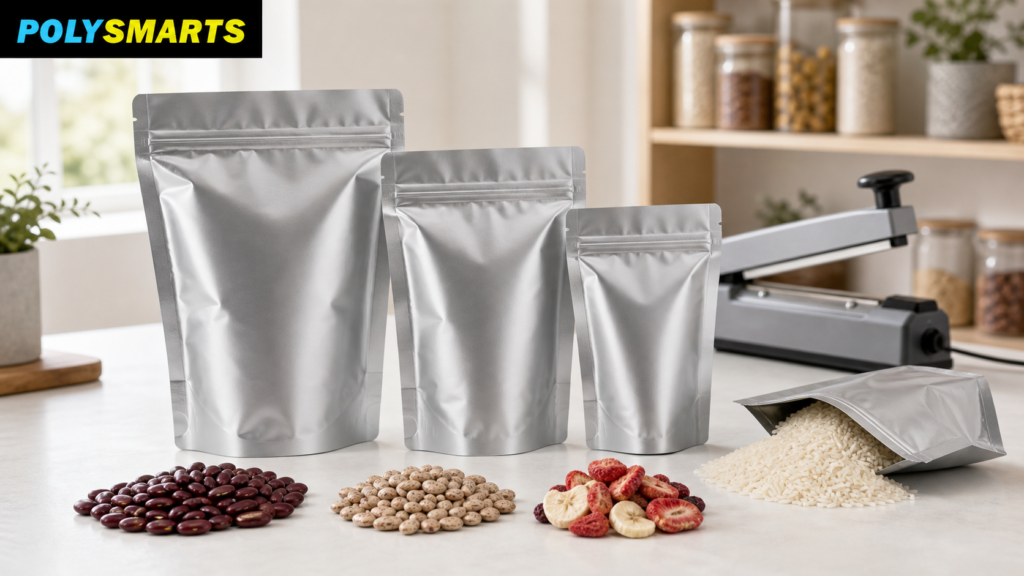
Empty pouches store flat and weigh less than many rigid containers. Filled pouches can be organized into practical portions, while an outer food-grade bucket or tote can add protection from crushing, puncture, and rodents. The pouch provides barrier functions; the outer container provides physical protection.
Several smaller bags can be more practical than one large package. Opening only what is needed helps protect the remaining food, simplifies date rotation, and limits the amount lost if one package is damaged. Smaller portions also make seal inspection and handling easier.
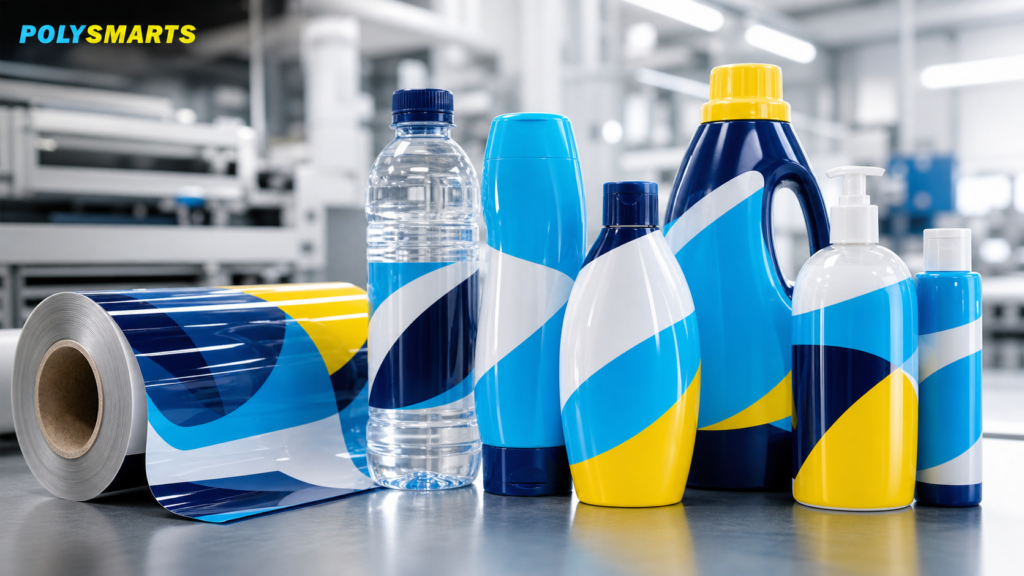
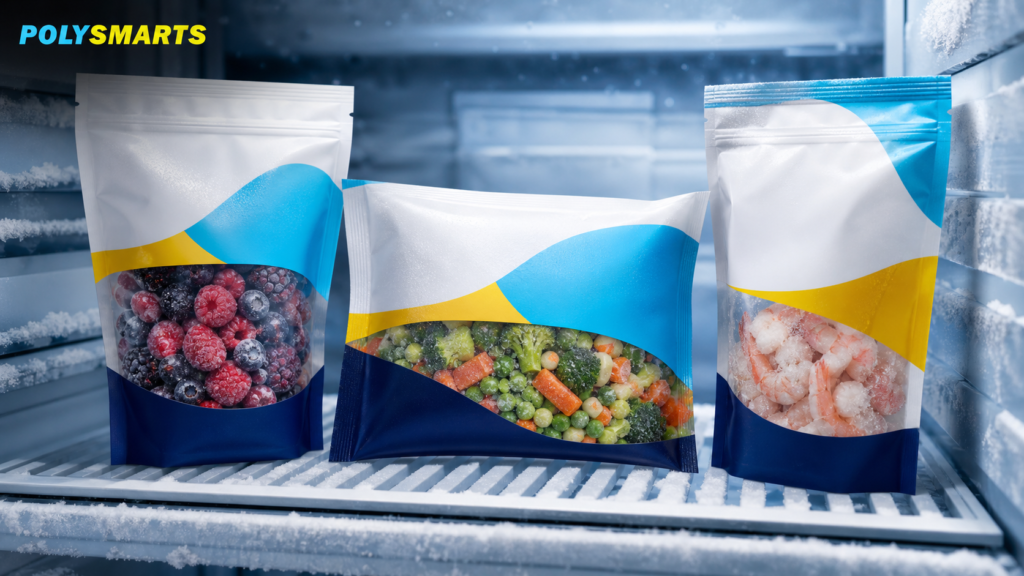
Commercial food brands can specify flat pouches, stand-up pouches, gussets, zippers, tear notches, hang holes, valves, finishes, and printed graphics. Polysmarts supports customization of bag shape, material, thickness, capacity, size, and printing. Confirm current capabilities and minimum order quantities for the exact project before placing an order.
Mylar-style pouches are most commonly associated with foods that are already dry and shelf-stable. Suitability still depends on initial quality, moisture or water activity, fat content, processing, packaging, and storage temperature.
On a phone, swipe horizontally to view the full comparison table.
| Food category | General fit | Key consideration |
|---|---|---|
| White rice, wheat, dried beans, pasta | Common dry-storage candidates | Package only clean, appropriately dry food; protect bags from insects and rodents |
| Properly dried or freeze-dried foods | Often suitable for moisture-resistant sealed packaging | Package promptly; drying does not necessarily kill disease-causing microorganisms |
| Powders, spices, tea, and coffee | Potentially suitable with a qualified structure | Aroma, oil, static, degassing, and seal contamination may require special design |
| Brown rice, nuts, seeds, whole-grain flour, oily foods | Usually shorter quality life than low-fat dry staples | Natural fats can become rancid; use conservative dating and rotation |
| Fresh, moist, wet, or improperly dried foods | Not suitable for casual reduced-oxygen room-temperature storage | A low-oxygen environment can create a serious botulism risk without a validated preservation process |
Food-safety warning: Do not add oxygen absorbers to moist food and store it at room temperature without validated expert guidance. Utah State University Extension warns that botulism may result when moist products are stored in reduced-oxygen packaging and advises that foods packaged in airtight containers with oxygen absorbers must be dry—about 10% moisture or less in its general long-term-storage guidance.
Commercial producers should control water activity and follow the regulations, process authority guidance, and food-safety plan applicable to the specific food and market. Packaging is not a substitute for a validated preservation process.
On a phone, swipe horizontally to view the full comparison table.
| Option | Useful strengths | Limitations to consider |
|---|---|---|
| Qualified Mylar-style barrier pouch | Lightweight, compact, heat-sealable, available with strong barrier options | Can be punctured or chewed; barrier and recyclability depend on the full structure |
| Ordinary zipper storage bag | Convenient for short-term organization | Usually not designed as a long-term oxygen, moisture, or light barrier |
| Food-grade bucket | Reusable rigid protection and convenient bulk storage | Barrier performance depends on the bucket and lid; bulky; often paired with an inner pouch |
| Glass jar | Reusable, easy to inspect, strong gas and moisture barrier when properly closed | Heavy, breakable, and transparent unless stored in darkness |
| Metal can | Rigid, opaque, and high barrier when correctly manufactured and sealed | Requires appropriate canning equipment and process; not a casual substitute for home-canning guidance |
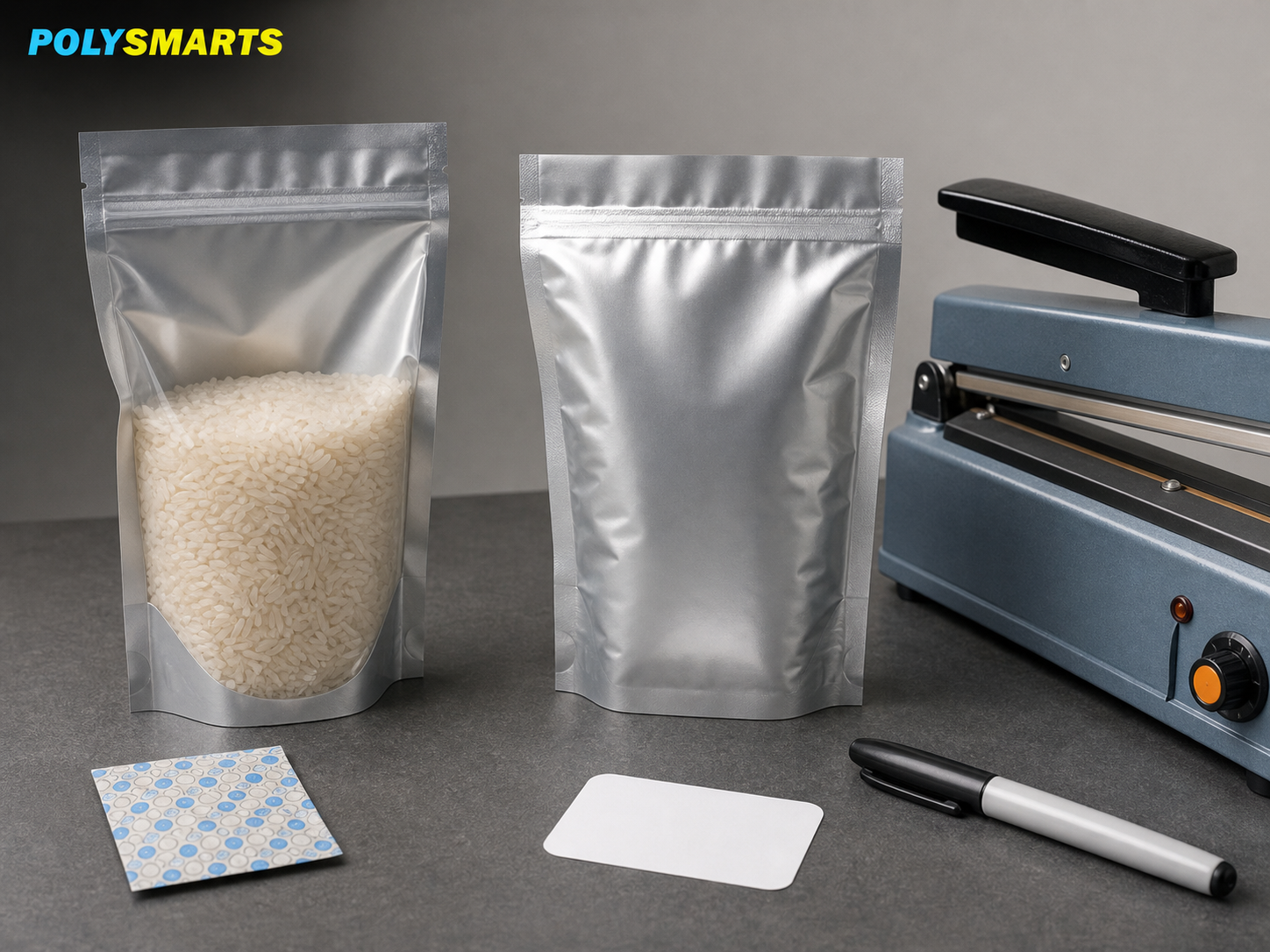
There is no honest universal shelf-life number for food stored in Mylar bags. Package structure is only one variable. Shelf life also depends on:
University of Minnesota Extension notes that published information for home freeze-drying shelf life remains limited, even though some commercially prepared freeze-dried products advertise long shelf lives. Treat product-specific shelf-life claims as something to validate through formulation knowledge, packaging data, and real-time or appropriately designed accelerated studies—not as an automatic benefit of the pouch name.
Identify the product’s sensitivity to oxygen, water vapor, light, aroma loss, grease, puncture, and seal contamination. Then turn those risks into measurable requirements such as oxygen transmission, water-vapor transmission, seal strength, and drop or puncture performance.
The U.S. Food and Drug Administration separates food types and conditions of use, including room-temperature filling, refrigeration, freezing, hot filling, sterilization, and cooking. Ask for documentation covering every relevant component of the finished structure under the proposed use conditions. Avoid the vague phrase “FDA-approved bag” unless the precise regulatory basis is clear.
A strong barrier may be essential, but opening, pouring, reclosure, shelf presentation, package stiffness, noise, and disposal also matter. Windows improve visibility but reduce full opacity. Zippers add convenience but also add cost and require sufficient headspace above the closure for production sealing.
Before scaling production, test representative filled samples through packing, sealing, shipping, storage, and consumer use. Confirm that the proposed pouch works on the actual equipment and remains intact through the expected distribution environment.
For a useful recommendation and quotation, provide:
Explore custom Mylar bags from Polysmarts Packaging and send the project details above to discuss a suitable sample and structure. Polysmarts currently lists customization for material, thickness, capacity, size, shape, and printing; confirm current specifications, MOQ, production schedule, and compliance documentation during quotation.
They can be a good option for appropriately dry, shelf-stable foods when the pouch has a suitable barrier, is properly heat-sealed, and is stored under controlled conditions. The bag does not create a fixed shelf life or replace safe food preparation.
Not every application does. Oxygen absorbers may benefit suitable dry foods, but they must be food-safe, correctly sized, and used according to reliable guidance. Never use them as a general solution for moist foods stored at room temperature.
You can package them, but high-fat foods and whole-grain products generally have a shorter quality life because their oils can become rancid. Use smaller portions, conservative dating, and regular rotation rather than assuming decades of storage.
Vacuum sealing and oxygen absorption are different methods. Some textured vacuum bags are not equivalent to moisture-barrier Mylar-style laminates. Choose the packaging system and equipment based on the food, desired protection, and validated process.
A zipper supports reclosure after opening, but long-term storage applications commonly use a continuous heat seal above it. Validate the seal for the exact film and equipment.
No. Food-contact suitability depends on the complete structure, substances used, manufacturing controls, food type, temperature, contact time, and intended conditions. Request documentation for the exact bag—not just the generic material name.
Yes. Flexible pouches are not rodent-proof. Store them inside a suitable rigid outer container when pests or physical damage are concerns.
Many conventional Mylar-style pouches are mixed-material laminates and are not accepted in ordinary curbside programs. Recyclability depends on the complete structure and the collection and processing system available in the target market.
Mylar bags for food storage offer useful barrier, sealing, storage-efficiency, portioning, and branding benefits—but only when the entire packaging system fits the food and process. Start with suitable dry food, verify the laminate and food-contact documentation, create and inspect a clean heat seal, use oxygen absorbers only where appropriate, and store the finished packages in cool, dry, protected conditions. Commercial brands should validate shelf life and filled-package performance instead of relying on the word “Mylar” alone.


 English English
  Français
 Español
 Deutsch
 Português
 日本語
日本語
 العربية
 한국어
한국어
 简体中文
简体中文