Animal food packaging protects pet food, treats, supplements, and feed while carrying the information buyers need to identify, store, and use the product. A more sustainable package is not simply one that looks natural. It is a package designed to use materials efficiently, protect the food through its intended shelf life, and support a credible end-of-life pathway without making unsupported environmental claims.
Quick answer: The best animal food packaging balances five requirements: product protection, seal integrity, consumer convenience, compliant labeling, and measurable environmental performance. Common improvement strategies include reducing material, designing mono-material structures, using verified recycled content where appropriate, right-sizing the package, and qualifying recyclability or compostability claims for the markets where the package will be sold.
Animal food packaging includes bags, pouches, cans, trays, cartons, and other containers used for dog food, cat food, pet treats, supplements, livestock feed, and related products. In consumer search, the phrase most often refers to pet food packaging.
The package must do more than hold the product. Depending on the formulation and distribution chain, it may need to manage:
A structure that works for dry kibble may not suit oily treats, powdered supplements, frozen raw food, or shelf-stable wet food. Material selection must begin with the product and process, not with a generic “green” label.
Sustainability is a set of measurable attributes and tradeoffs. A credible packaging decision considers material inputs, manufacturing, product protection, transport, consumer use, collection, sorting, and actual recovery or disposal.
The U.S. Federal Trade Commission advises marketers not to make broad, unqualified environmental-benefit claims. Terms such as “eco-friendly,” “green,” “recyclable,” “compostable,” and “made with recycled content” should be specific, substantiated, and appropriately qualified.
Source reduction can lower package weight and shipping volume. However, downgauging too far can increase punctures, seal failures, or food waste. The goal is not the thinnest possible film; it is the lowest material use that still passes filled-package testing.
Mono-material polyethylene or polypropylene structures may improve compatibility with certain film-recycling systems compared with mixed-material laminates. “Mono-material” does not automatically mean curbside recyclable, and access varies by location. Closures, valves, inks, coatings, adhesives, and barrier layers must also be considered.
Recycled-content claims should state the verified percentage and whether it is post-consumer or pre-consumer material. Food-contact applications require appropriate regulatory review and documentation for the intended use. A certificate covering a facility or material category does not by itself prove that every finished pet food pouch contains a particular percentage of recycled content.
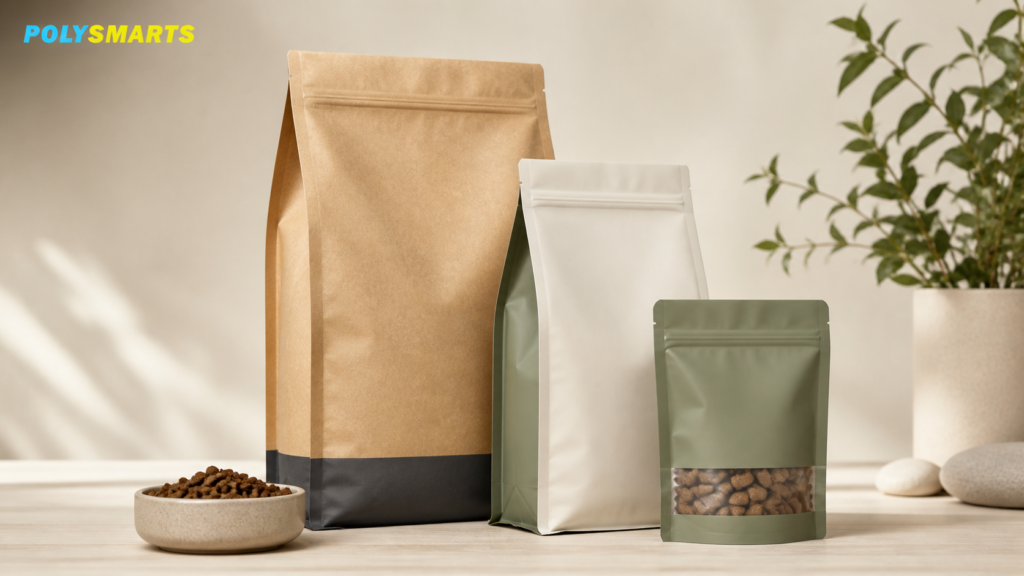
Kraft paper can add stiffness, tactility, and a natural visual identity. Many kraft-look pet food bags also contain polymer, foil, coatings, or adhesives needed for sealing and barrier performance. The package should not be described as paper-recyclable unless the complete construction is accepted by the claimed paper-recycling pathway.
Compostable packaging needs evidence for a recognized composting condition and clear disposal instructions. Industrially compostable is not the same as home compostable. The FTC recommends disclosing limited facility availability when consumers are unlikely to have access to an appropriate composting program.
On a phone, swipe horizontally to view the full comparison table.
| Strategy | Potential advantage | Important limitation | Evidence to request |
|---|---|---|---|
| Reduced-gauge flexible laminate | Uses less material and can reduce shipping weight | Must still withstand filling, sealing, stacking, drops, and distribution | Material-weight comparison and filled-package test results |
| Mono-material PE or PP design | May align with compatible flexible-film recycling streams | Barrier, stiffness, heat resistance, and local collection can be constraints | Full bill of materials, recyclability assessment, and market-specific collection guidance |
| Conventional multilayer high-barrier pouch | Can combine strong barrier, print, seal, and mechanical functions | Mixed layers are often difficult to separate and recover | OTR, WVTR, seal, migration, and distribution data for the named structure |
| Kraft-look or paper-containing laminate | Natural appearance, print surface, and stiffness | A polymer or foil lining may prevent paper-stream acceptance | Layer composition and repulpability or recycling-pathway evidence |
| Verified recycled-content structure | Can reduce demand for virgin resin | Food-contact use, consistency, color, odor, and supply may require controls | Chain-of-custody evidence, percentage by weight, and food-contact documentation |
| Certified compostable structure | May suit a defined composting system | Barrier, seal, storage life, cost, and facility access can limit use | Certification scope, composting conditions, and disposal-access evidence |
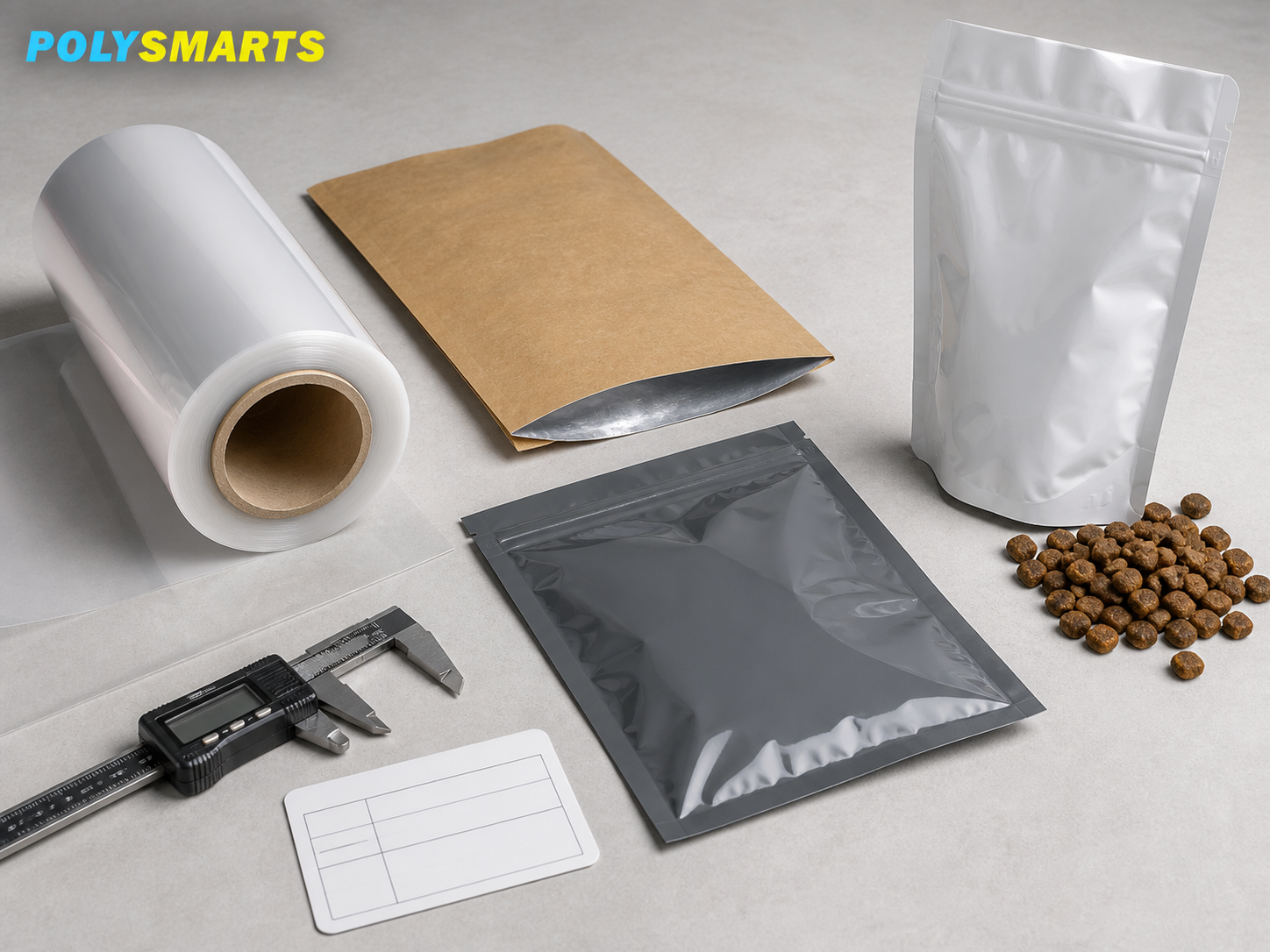
Large dry-food formats commonly use side-gusset, quad-seal, or flat-bottom bags because these shapes can provide efficient shelf presentation and capacity. Larger bags need careful testing for seam strength, drop resistance, carrying, pouring, and reclosure.
Stand-up pouches and smaller flat pouches can suit jerky, biscuits, freeze-dried treats, dental chews, and training treats. Zippers, tear notches, and hang holes can improve convenience, but each feature affects material use, sealing, and recycling compatibility.
Powdered animal-food products require attention to fine-particle contamination in the seal area, static, aroma, moisture sensitivity, dosing, and tamper evidence. The packaging specification should match the actual powder and filling equipment.
These products may require refrigeration, freezing, retort processing, hot filling, or another validated preservation process. Do not substitute a general dry-food pouch based on appearance. Food-contact materials, seals, process resistance, and microbial controls must be qualified for the specific application.
Pet food commonly contains fats, flavors, vitamins, minerals, and proteins that can respond to oxygen, moisture, light, and heat. Packaging may help manage these exposures, but it cannot correct poor formulation, contamination, or inadequate processing.
Ask for test results under named methods and conditions. Barrier values for an unconverted film do not automatically describe the performance of a printed, laminated, formed, filled, and sealed package.
The U.S. Food and Drug Administration states that an animal food label should describe the product and include details needed for safe and effective use. Ingredient statements, identity, net quantity, manufacturer or distributor information, directions, and claims may be subject to federal and state requirements.
Packaging artwork must reserve sufficient space and contrast for mandatory information, nutrition or guaranteed-analysis content where applicable, ingredient statements, lot codes, date codes, barcodes, and safe-use instructions. Disease-treatment or prevention claims can change a product’s regulatory status and require specialist review.
Lot coding is also operationally important. FDA advises pet owners to retain the lot number, UPC, product name, manufacturer, and best-by date because those details help identify products when a complaint or recall occurs.
A useful quotation starts with a complete application brief. Provide:
Explore custom pet food packaging from Polysmarts. The current product page describes customizable printing, resealable closures, tear notches, windows, side-gusset and flat-bottom formats, and published starting quantities for digital prototyping and full production. Confirm the current structure, performance, MOQ, lead time, and documentation for your specific project during quotation.
There is no single best material. The correct structure depends on the food’s fat and moisture content, barrier needs, processing, bag size, distribution, intended shelf life, consumer use, and recovery pathway.
Flexible packaging can use less material and transport volume than some rigid alternatives, but its environmental result depends on product protection, material structure, manufacturing, collection, and actual recovery. Make comparisons with defined boundaries and evidence.
Some may be compatible with specific recycling programs, while conventional mixed-material laminates often are not accepted through curbside systems. Check the full structure and collection access in the market where the bag is sold before making a claim.
Not automatically. A kraft exterior may be laminated to plastic or foil for barrier and sealing. Evaluate the complete construction, material weight, product-protection performance, and end-of-life pathway.
Potentially, depending on the material, layer location, manufacturing process, intended food-contact use, and applicable authorization. Require specific food-contact and chain-of-custody documentation.
Keep the product name, manufacturer, UPC, lot code, best-by date, ingredient and feeding information, and relevant storage instructions. FDA notes that lot details help investigate complaints and recalls.
FDA recommends a cool, dry location. If transferring dry food to another container, use a clean, dry container with a snug lid and retain the original identification and lot information. Putting the original bag inside the container can preserve that information and reduce contact with residue from prior food.
Effective animal food packaging begins with product protection and ends with evidence. Choose a format and material structure that can be filled, sealed, shipped, stored, opened, and disposed of as intended. Then substantiate each sustainability claim—whether it concerns reduced material, mono-material design, recycled content, recyclability, or compostability. That approach protects the animal food, the pet owner, the brand, and the credibility of the environmental message.
 English English
  Français
 Español
 Deutsch
 Português
 日本語
日本語
 العربية
 한국어
한국어
 简体中文
简体中文