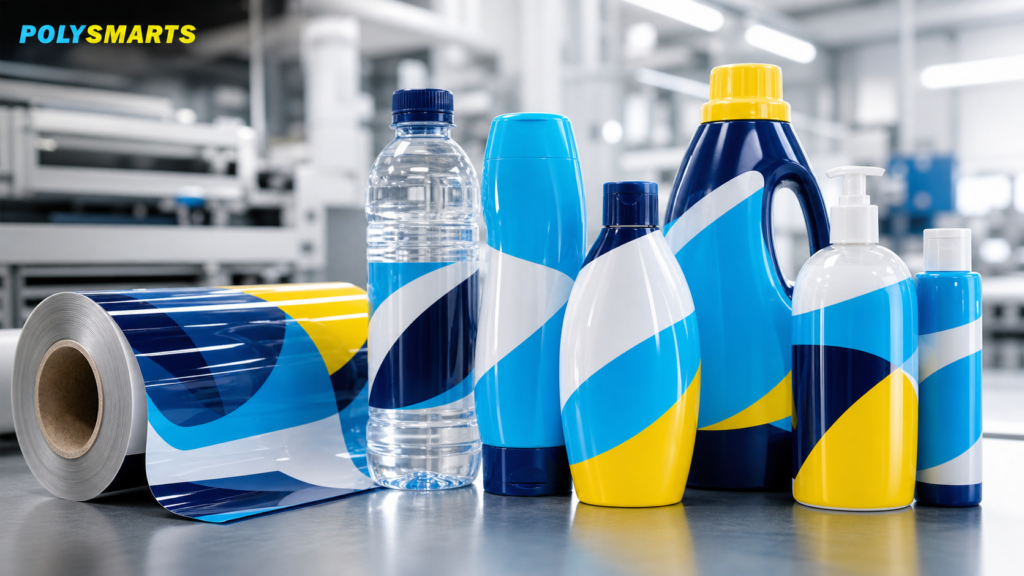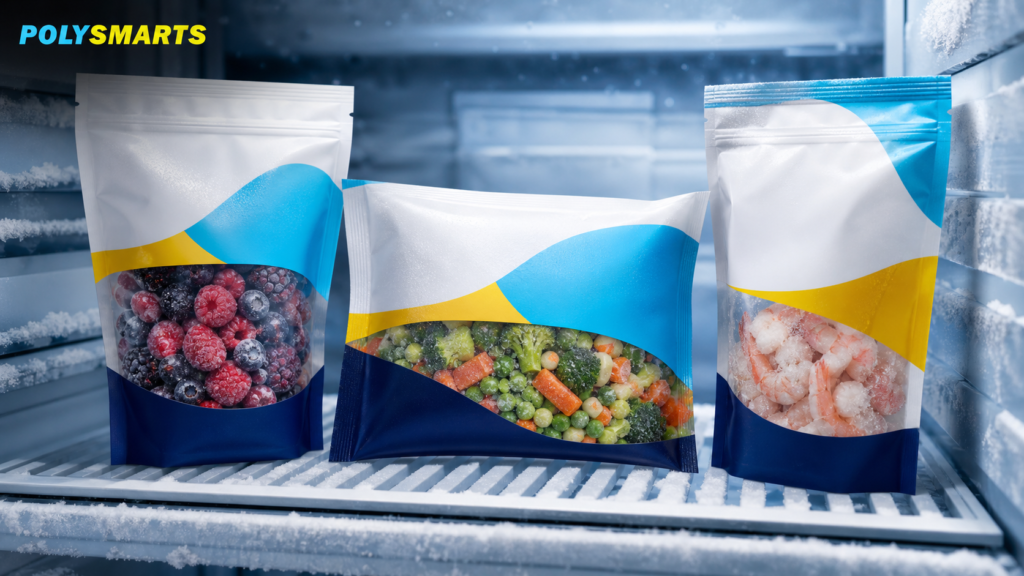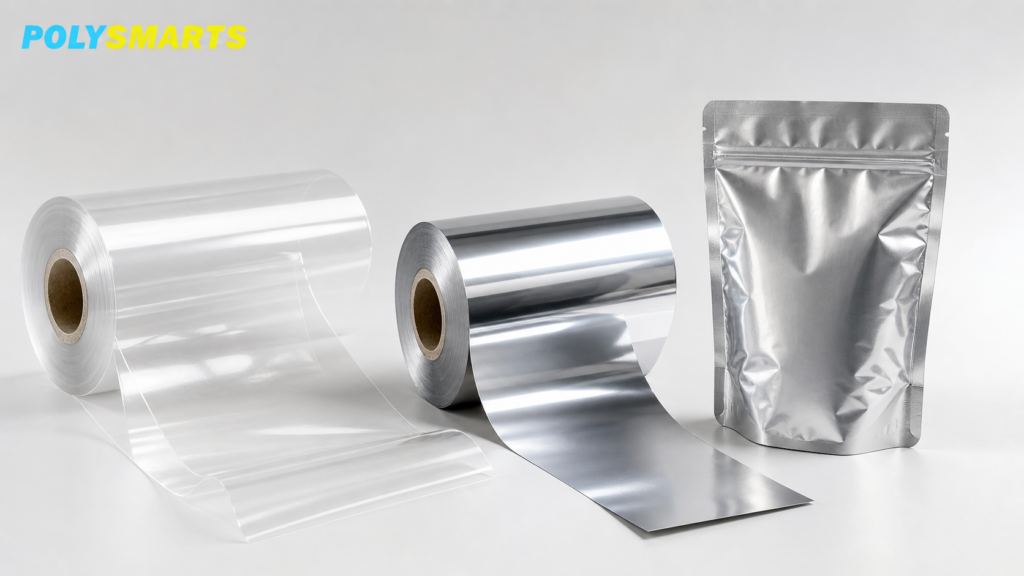
Mylar® is a brand of biaxially oriented polyethylene terephthalate (BoPET) film. The film begins as PET plastic and is stretched in two directions to improve strength, dimensional stability, and other useful properties. Mylar film is naturally clear—not automatically silver, foil, or a finished bag.
Quick answer: What is Mylar? Strictly speaking, Mylar® is a registered trademark for a family of PET films. In everyday packaging language, “Mylar bag” often describes a pouch that uses PET or metallized PET as one layer in a larger laminated structure. The pouch may also include aluminum foil, another barrier film, adhesives, inks, and a heat-seal layer. Its performance depends on that complete structure.
Mylar film is made from polyethylene terephthalate, or PET, a polyester. During film production, PET is formed into a thin sheet and oriented in both the machine and transverse directions. This biaxial orientation is the reason for the abbreviation BoPET.
Orientation changes how the polymer chains are arranged and helps produce a thin film with a useful balance of tensile strength, toughness, clarity, and dimensional stability. Manufacturers can then tailor the film with coatings, surface treatments, or other processing for a particular application.
The name requires a technical distinction. Mylar Specialty Films identifies Mylar® as a registered trademark for its PET film. Other manufacturers produce BoPET under different trade names, so not every polyester film is literally Mylar-brand film.
Base Mylar film is plastic. It can be metallized by depositing a very thin metal coating—commonly aluminum—onto the film. Metallized PET looks reflective, but it is not the same material as a separate sheet of aluminum foil.
A finished flexible pouch can combine several materials. For example, an outer PET layer may support printing and handling, a metallized film or foil layer may improve barrier performance, and an inner sealant layer may allow the package to be heat-sealed. The exact construction must be selected for the product and process.
On a phone, swipe horizontally to view the full comparison table.
| Term | What it means | Typical appearance | Packaging role |
|---|---|---|---|
| Mylar® PET film | A branded polyester film | Usually clear unless coated, colored, or metallized | Structural, printable, protective, or specialty film layer |
| BoPET | The generic material category: biaxially oriented PET | Typically clear | Used in packaging, labels, insulation, and other films |
| Metallized PET | PET film with a very thin deposited metal coating | Reflective or silver | Adds opacity, reflectivity, and structure-dependent barrier |
| Aluminum foil laminate | A laminate containing a distinct foil layer | Opaque and metallic | Can provide a strong light, gas, and moisture barrier when properly converted and sealed |
| “Mylar bag” | An informal market term for a flexible pouch often containing PET or metallized PET | Clear, printed, matte, glossy, holographic, or metallic | A finished package whose performance depends on all layers, seals, and features |
No single layer needs to do every job. Flexible packaging converters combine materials so that each layer contributes a useful function.
PET film is commonly used toward the outside of a laminate because it handles well and can provide a stable surface for reverse printing. Reverse printing places ink behind a transparent outer film, helping protect the graphics from abrasion.
A packaging structure may use metallized PET, aluminum foil, or another barrier material to reduce the transmission of light, oxygen, aroma, or water vapor. These are not interchangeable benefits. Barrier values depend on the selected materials, their thicknesses, coating quality, lamination, folds, and package seals.
A separate inner film often provides heat-seal performance and becomes the product-contact surface. The correct sealant depends on filling temperature, storage conditions, product composition, processing method, and intended use.

Specific values vary by film grade, thickness, coating, and test method, but oriented PET films are widely selected for several practical reasons:
For packaging buyers, the main benefit is design flexibility: PET can be combined with other layers and converted into pouches, rollstock, lidding, or other formats. That flexibility does not mean every PET-based package has the same performance.
Clear PET alone is not equivalent to a foil laminate. If oxygen, moisture, aroma, or light control is critical, request measured transmission data for the proposed full structure rather than relying on the word “Mylar.”
Metallized PET can look like foil while using only a thin deposited metal layer. Foil and metallized film differ in barrier, flex resistance, appearance, cost, and converting behavior. The better option depends on the product and distribution conditions.
A pouch should not be described as food-safe merely because it contains PET. The U.S. Food and Drug Administration explains that the regulatory status of a food-contact material depends on the substances in the article and their authorized conditions of use. Product type, contact time, temperature, and processing conditions matter. Ask the supplier for documentation covering the complete proposed structure and intended use.
Combining PET, sealants, foil, coatings, inks, and adhesives can improve package function but complicate material recovery. Do not assume a “Mylar bag” is curbside recyclable. Check the complete structure and the acceptance rules of the relevant local collection program before making a recycling claim.
Mylar and other BoPET films appear in many industries. Applications include:
In consumer packaging, PET-based laminates are used for products such as coffee, tea, snacks, powders, pet treats, supplements, cosmetics, and non-food goods. The package must still be qualified for the actual contents and supply chain.
“Mylar bags” is a common commercial term for flexible pouches made with PET-based laminate structures. They may be flat pouches, stand-up pouches, side-gusset bags, or shaped packages. Options can include zippers, tear notches, hang holes, valves, spouts, windows, matte or gloss finishes, and custom printing.
Polysmarts offers custom Mylar bags and supports decisions involving bag shape, material selection, thickness, capacity, and printing. Availability and suitability should be confirmed against the product, required barrier, filling process, destination market, and order details.
A useful packaging quote starts with application details. Send:
Discuss a custom Mylar bag project with Polysmarts Packaging. The more complete the application brief, the easier it is to compare structures and prepare meaningful samples.
Mylar® is a trademarked polyester film made from biaxially oriented PET. In casual use, people often use “Mylar” for reflective films or flexible barrier pouches, although those products may contain additional materials.
Mylar is a brand of PET film. PET is the polymer family; BoPET is PET film stretched in two directions; Mylar® is a trademark used for particular PET films.
No. Base Mylar film is polyester plastic. It can be coated with a thin metal layer or laminated with aluminum foil, which creates the familiar silver appearance and can change barrier performance.
A properly designed and sealed pouch can provide a strong package seal, but “Mylar” alone does not guarantee airtightness. Sealant choice, seal settings, contamination in the seal area, closure design, and workmanship all affect integrity.
The film layers may resist liquid water, but a finished package’s protection depends on seams, closures, fitments, pinholes, and intended exposure. Use application-specific testing instead of assuming all Mylar bags are waterproof.
They can be suitable for food when every component of the proposed structure is authorized for the intended food type and conditions of use. Request supporting food-contact documentation for the exact pouch construction.
Many conventional Mylar-style pouches use mixed-material laminates that are not accepted in ordinary curbside programs. Recyclability depends on the complete structure and the local collection and processing system.
What is Mylar? It is a trademarked BoPET film—not automatically aluminum foil and not, by itself, a complete packaging specification. In flexible packaging, PET may contribute strength, printability, and stability while metallized film, foil, sealants, coatings, and closures provide other functions. Choose a Mylar bag by its verified full structure and intended use, not by appearance or name alone.


 English English
  Français
 Español
 Deutsch
 Português
 日本語
日本語
 العربية
 한국어
한국어
 简体中文
简体中文