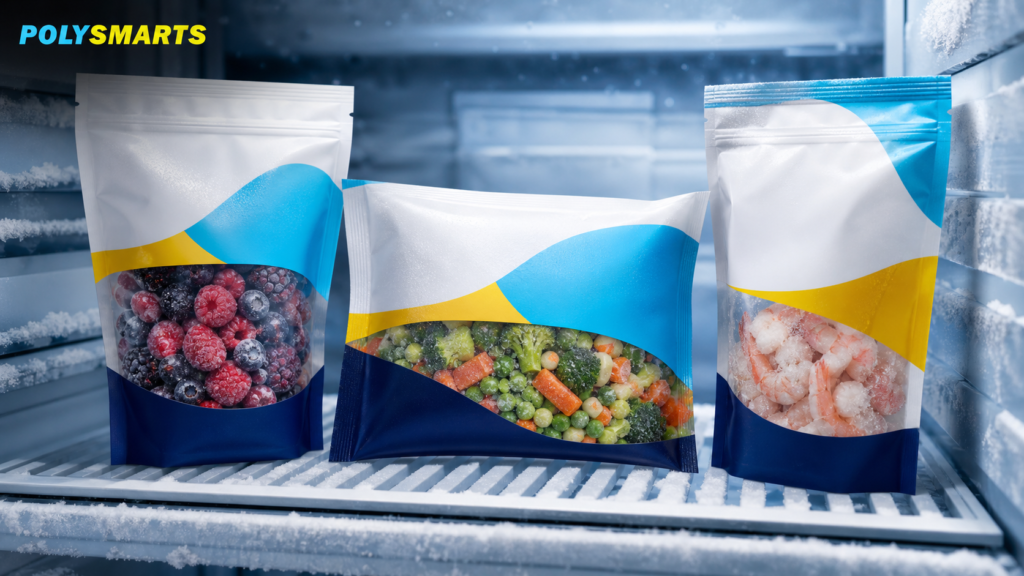
Frozen food packaging must remain intact and seal reliably through filling, freezing, storage, transport, retail handling, and consumer use. The right package limits moisture loss and air exposure, resists puncture and flex cracking at low temperature, fits the filling line, and carries clear storage and preparation instructions. No single film or pouch structure is best for every frozen product.
Quick answer: Choose frozen food packaging by matching the food’s moisture, fat, shape, sharpness, fill temperature, storage duration, distribution abuse, and cooking method to a tested package structure. Start with seal integrity, low-temperature toughness, moisture-vapor protection, puncture resistance, and food-contact suitability. Then add convenience, graphics, and end-of-life goals without compromising product protection.

Frozen food packaging includes flexible bags, stand-up pouches, vacuum pouches, lidding films, trays, cartons, and rollstock designed for products distributed and stored in a frozen state. Flexible packaging commonly combines a printable outer surface, structural or barrier layers, and a sealant layer, but the exact construction varies by product and process.
Freezing helps control microbial growth, but it does not sterilize food. The U.S. Food and Drug Administration (FDA) and U.S. Department of Agriculture (USDA) advise maintaining freezers at 0°F (−18°C) for safe long-term storage. Food quality can still decline over time, especially when air reaches the food or moisture escapes through an inadequate package or seal.
Freezer burn is dehydration at the food surface. It creates dry, discolored areas and affects quality rather than making food unsafe by itself. A suitable moisture-vapor barrier, low headspace where appropriate, sound seals, and protection from punctures help limit the pathways through which moisture leaves and air enters.
Oxygen can contribute to oxidation, color change, and flavor deterioration in susceptible foods. The required oxygen barrier depends on the product, expected shelf life, headspace, processing method, and storage conditions. Do not select a “high-barrier” structure without defining a target and reviewing data under relevant temperature and humidity conditions.
Some materials become stiffer or more brittle as temperature falls. Packages can be dropped, flexed, compressed, or struck by hard product edges during cold storage and distribution. Low-temperature impact, flex-crack, puncture, seal, and drop testing should represent the actual filled package—not only an unfilled room-temperature film sample.
A strong film cannot compensate for a contaminated, wrinkled, underheated, or overheated seal. Ice, oil, powder, product particles, condensation, seal-jaw settings, dwell time, pressure, and cooling can all affect seal performance. Validate the sealing window on the intended equipment and line speed.
The package must carry required identity, ingredient, allergen, net-quantity, manufacturer, storage, preparation, lot, and date information as applicable. If consumers heat food in the package, that is a different condition of use from frozen storage alone and requires a structure specifically assessed for the heating method and temperature.
Material names alone do not establish performance. Thickness, grade, orientation, additives, coatings, lamination, seals, and the finished format all matter.
Phone users can swipe horizontally to view the full table.
| Material or structure family | Potential strengths | Important limitations | Questions to verify |
|---|---|---|---|
| Polyethylene-based film | Heat sealing, flexibility, moisture resistance, and potential for PE-focused design-for-recycling | Oxygen barrier, stiffness, puncture, optics, and heat resistance vary widely by grade and construction | Cold impact, seal window, thickness, barrier data, and recovery acceptance in the destination market |
| Polypropylene-based film | Clarity, stiffness, print surface, and moisture protection in suitable structures | Low-temperature toughness must be confirmed for the selected grade and package | Brittleness at use temperature, sealant choice, impact, and flex testing |
| Polyamide/PE structure | Potential puncture and abuse resistance for bone-in, sharp, or vacuum-packed products | Multimaterial construction may complicate mechanical recycling; moisture can affect some properties | Layer composition, thickness, puncture data, vacuum use, and disposal route |
| PET/PE or other printed laminate | Printability, stiffness, dimensional stability, and tailored sealant performance | Performance and recyclability depend on the full laminate; not automatically suitable for every frozen food | Exact layers, adhesive, cold-flex behavior, barrier, seal, and food-contact documentation |
| Foil or metallized barrier laminate | High light and gas barrier when intact, depending on construction | Opacity, flex-crack risk, microwave restrictions, metal detection interactions, and difficult recovery pathway | Whether this barrier level is needed; flex testing; cooking instructions; inspection compatibility |
| Paperboard carton plus inner pack | Stacking, print area, protection, and familiar shelf presentation | Usually relies on an inner package for moisture and seal performance; condensation can reduce board strength | Inner-pack function, wet strength, freezer display, material use, and component separation |
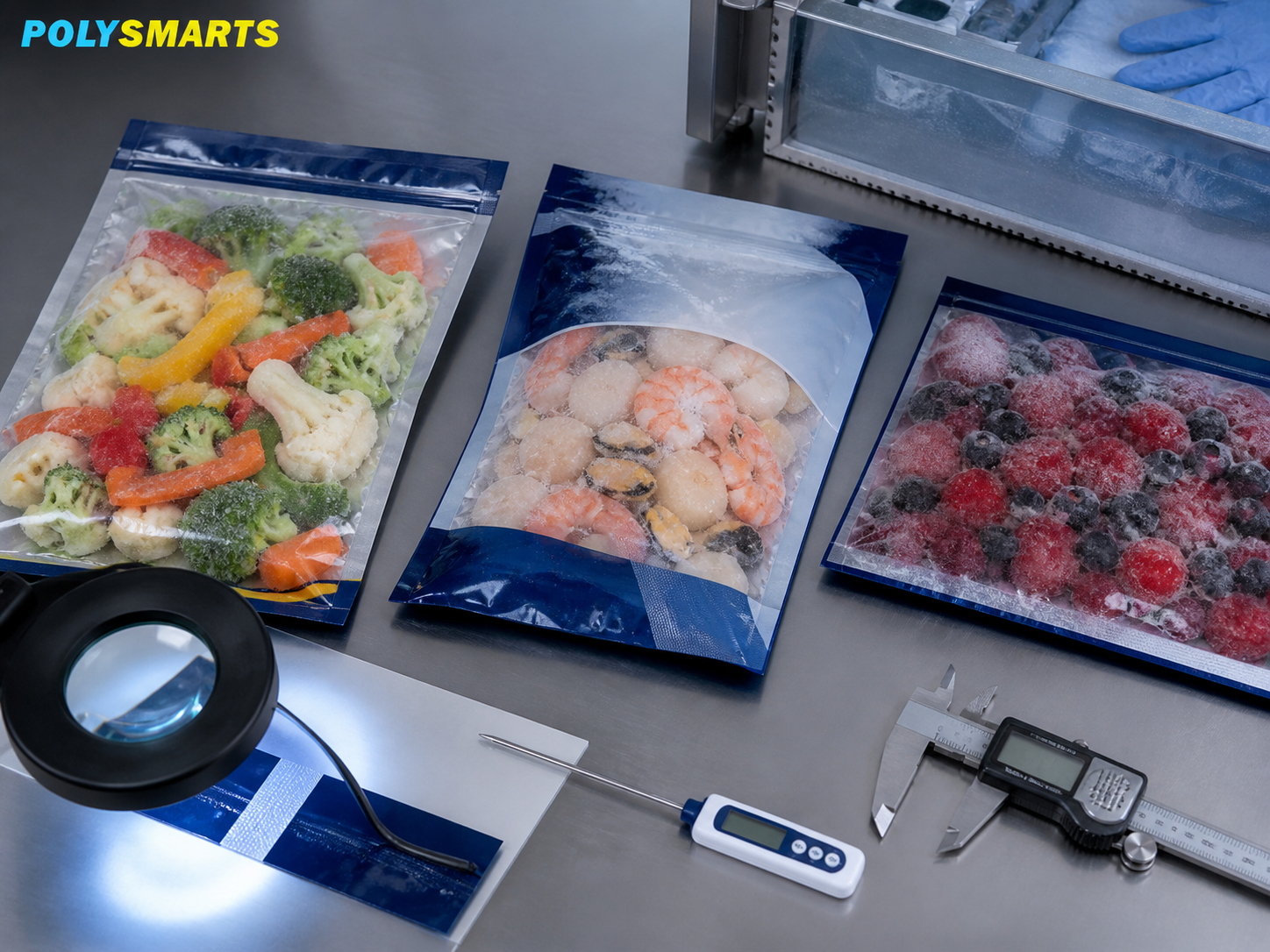
These efficient formats are widely used for vegetables, fruit, fries, and other products filled on form-fill-seal equipment. Film machinability, seal contamination tolerance, drop performance, and retail display drive selection.
A bottom gusset provides shelf presentation and can support reclosure for multi-use foods. The gusset, zipper, and intersections create additional seal geometry that must survive filling and freezing.
Removing air can reduce headspace and oxygen exposure for suitable products. Products with bones, shells, or sharp frozen edges may need enhanced puncture resistance. Vacuum packaging does not replace sanitation, temperature control, or validated processing.
Printed or unprinted rollstock can run on vertical or horizontal form-fill-seal systems. Confirm web width, repeat length, unwind, coefficient of friction, registration, forming behavior, seal range, and line speed.
Trays provide shape and compression protection for meals, proteins, and portioned products. Tray and lid compatibility, flange cleanliness, seal peel, fogging, headspace, heating, and case packing require evaluation.
A risk-based qualification plan may include:
Test methods, sample conditioning, acceptance criteria, and responsibility should be agreed before production. A supplier datasheet can support selection, but it does not replace testing the actual converted package with the actual food.
A package that prevents product dehydration, leakage, or damage can avoid food loss, but that does not make every environmental claim valid. Evaluate the minimum structure that meets protection requirements, efficient package dimensions, production waste, transport, and an end-of-life pathway that exists in the destination market.
Mono-material-oriented structures may improve compatibility with a polyethylene or polypropylene recycling stream, but only if the full package—including barrier coatings, adhesives, inks, zippers, valves, and labels—meets the applicable program’s criteria. “Recyclable,” “biodegradable,” and “compostable” claims require evidence and appropriate qualification. Cold performance and seal reliability remain essential.
Explore custom frozen food packaging from Polysmarts for currently presented formats and features, including stand-up and lay-flat pouches, rollstock, vacuum packaging, zippers, and tear notches. Treat the page’s example materials and temperature statements as starting points; confirm the exact construction, documentation, testing, minimum quantity, and lead time for your product before ordering.
There is no universal best material. A suitable structure must seal reliably, limit moisture loss, remain tough at the target temperature, resist the product’s edges, and meet the required food-contact and processing conditions. Compare named structures using filled-package testing.
Freezer burn occurs when moisture leaves the food surface and air reaches it, producing dry and discolored areas. It is a quality issue, not a safety issue by itself. Airtight packaging, sound seals, and appropriate moisture-vapor protection can help reduce it.
No. Freezing generally stops bacteria from growing while the food stays frozen, but many microorganisms can become active again after thawing. Safe processing, an intact package, temperature control, and proper thawing and cooking remain necessary.
FDA and USDA consumer guidance recommends maintaining a freezer at 0°F (−18°C). A commercial product’s validated cold-chain limits and storage instructions may be more specific and should be followed.
Some may qualify for a particular collection and recycling program, while many multilayer structures do not. The answer depends on every layer and component, package size, contamination, local collection, sorting, and reprocessing rules. Verify the finished package for the destination market before making a claim.
Only if the complete pouch has been designed, assessed, and clearly instructed for that microwave use. Frozen storage alone does not establish microwave suitability. Foil, metallized layers, inks, adhesives, vents, seals, and heating temperatures all matter.
A zipper can improve convenience for multi-serve products, but it adds cost and another component to the package. The primary seal must protect unopened product; the zipper’s function after freezing, contamination, and repeated use should be tested.
Fill and seal production-representative pouches, freeze and condition them under the expected cold chain, then evaluate seals, leaks, drops, puncture, flex cracking, compression, graphics, coding, and opening features against agreed criteria. Include temperature cycles and distribution simulation when relevant.
Reliable frozen food packaging is an engineered system, not simply a thick bag or a “freezer-safe” label. The best choice matches food composition, sharpness, fill and sealing conditions, frozen distribution, storage time, consumer use, and end-of-life goals with a documented package structure and realistic testing. Protect the product first, then optimize convenience, graphics, material use, and cost.
For a product-specific discussion, review Polysmarts’ frozen food packaging options and provide the application details in the quotation checklist above.
 English English
  Français
 Español
 Deutsch
 Português
 日本語
日本語
 العربية
 한국어
한국어
 简体中文
简体中文