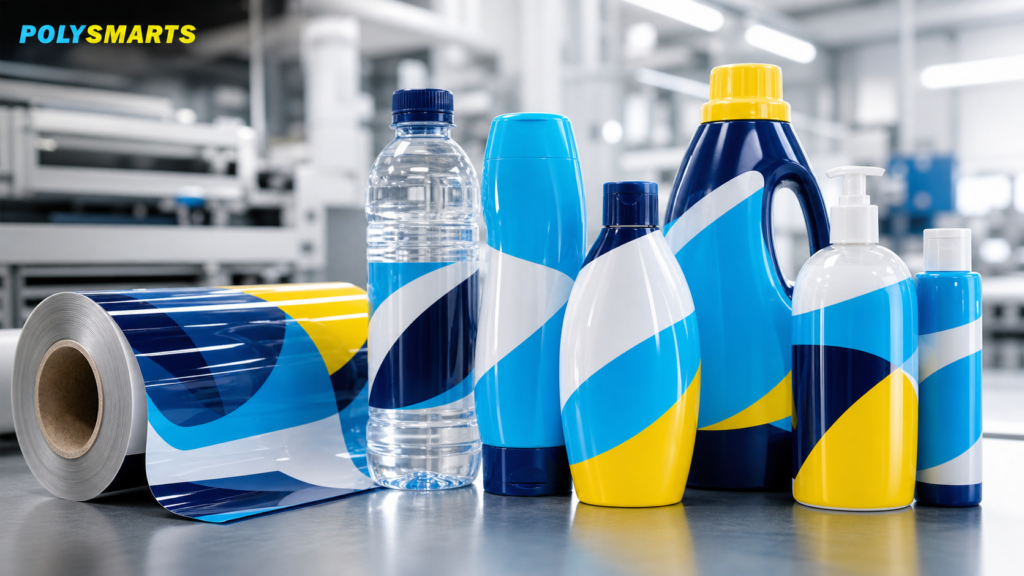
Printed plastic bags are flexible packages decorated with brand artwork, product information, or variable graphics before or after the film is converted into a finished bag. For commercial packaging, the main printing choices are digital, flexographic, and gravure. The right option depends on the film, bag format, run length, number of designs, color and detail requirements, finishing, conversion process, regulatory needs, and total project economics.
Quick answer
Define the bag and product requirements before choosing a print process. Obtain the converter’s dieline, prepare production artwork, identify color targets and variable versions, approve the right type of proof, and validate printing on the actual film and formed bag. A screen PDF can confirm content and position, but it cannot by itself prove production color, ink adhesion, scuff resistance, registration, seals, barcode performance, or package durability.

Most custom flexible packaging begins as a web of film rather than an individual empty bag. The web is printed, and it may then be coated or laminated to another film. During conversion, equipment slits, folds, seals, cuts, and adds components such as zippers, valves, or spouts. Rollstock may instead be shipped to the brand or co-packer for forming, filling, and sealing on packaging equipment.
Printing on plastic requires control of more than artwork. Film surface energy, ink chemistry, curing or drying, treatment age, lamination bond, heat exposure, slip additives, winding, and storage can affect adhesion and appearance. The final print also has to tolerate flexing, abrasion, filling, sealing, distribution, and consumer handling.
| Method | Image carrier | Often considered for | Important tradeoffs |
|---|---|---|---|
| Digital | Digital file; no conventional plates or cylinders | Multiple SKUs, test launches, variable graphics, frequent changes, shorter runs | Available films and finishes, white ink, color matching, overprint protection, conversion, cost at scale |
| Flexographic | Flexible relief plates | Recurring medium or larger runs across many flexible substrates | Plate cost, screening, trapping, minimum type, tonal range, setup waste, repeat consistency |
| Gravure | Engraved cylinders | Long repeat orders requiring high-detail and consistent reproduction | Cylinder investment, setup, revision cost, lead time, run-length economics |
Phone users can swipe horizontally to view the complete table.
No method is automatically best. Ask suppliers to quote the same finished specification and expected reorder pattern. Compare setup costs, price at realistic volumes, waste, number of artwork versions, color control, proofing, finishing, and the cost of future changes—not just the first unit price.
Print planning changes with the package geometry. Stand-up pouches provide front and back panels plus a bottom gusset, but artwork can disappear into the gusset or seal zones. Flat and three-side-seal pouches have simple panels but less display area. Flat-bottom and side-gusset bags create several visible faces that require careful panel alignment. Pillow bags and rollstock depend on repeat length, eye marks, web direction, and form-fill-seal geometry. Die-cut handles, windows, zippers, spouts, valves, and tear features all reduce or reshape usable print areas.
To explore commercial options, review Polysmarts’ custom packaging bags. Confirm the final dieline and construction with the supplier before adapting artwork.
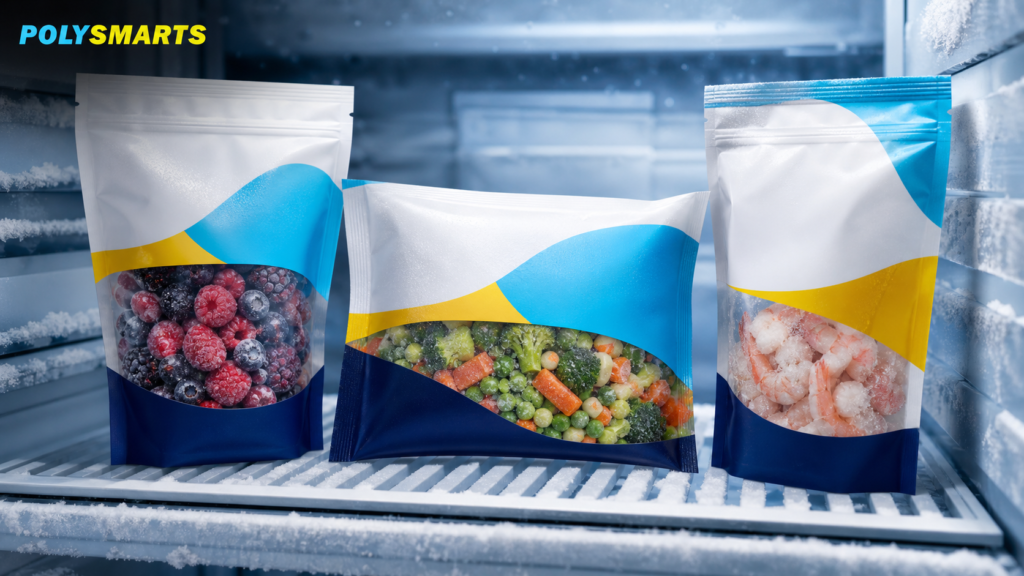
Printed plastic bags are used for dry foods and snacks, coffee and tea, frozen products, pet food and treats, powders and supplements, cosmetics, household products, apparel, ecommerce items, and sensitive industrial components. The print brief changes with the product. A food pouch may need reverse printing protected inside a laminate and documentation for its intended contact conditions. A frozen pouch must retain print and package integrity through cold handling and abrasion. A clear apparel bag may prioritize opacity control, suffocation warnings, adhesive closure, and barcode scanning. An electronics bag may need functional electrostatic or moisture protection that branding must not compromise.
For every application, define whether the bag is primary packaging, secondary packaging, or a retail carry bag. That distinction changes product contact, warnings, barrier, sealing, testing, and regulatory responsibilities.

| Approval item | Useful for | Does not prove by itself |
|---|---|---|
| Screen PDF | Copy, layout, version, approximate position | Production color, substrate appearance, ink adhesion, finish |
| Contract color proof | Defined color expectation under stated conditions | Formed-bag geometry, seals, final substrate effects unless simulated |
| Prototype or mockup | Size, fill fit, hierarchy, shelf view, usability | Full-run repeatability or exact production print when made differently |
| Press or production sample | Actual film, ink, print, finish, conversion, and physical reference | Shelf life or line performance without representative filled-package tests |
Phone users can swipe horizontally to view the complete table.
Set acceptance criteria before production. Depending on the application, inspect color against the approved standard, print-to-cut registration, repeat length, missing or contaminated print, streaking, pinholing, blocking, scuffing, ink adhesion, odor, cure, lamination appearance, bond integrity, dimensions, seal placement, zipper alignment, and bag cleanliness.
Barcodes and variable codes should be verified on production material after forming and filling, especially when gloss, curvature, wrinkles, transparent areas, or metallic effects are present. Use an agreed sampling plan and record which approved proof or signed sample controls the result. Retain samples from the beginning, middle, and end of the run for investigation and reorder comparison.
If a printed bag contacts food, the regulatory assessment covers the complete food-contact material and its intended use. Films, sealants, adhesives, colorants, coatings, and other components may be relevant. Food type, temperature, duration, and processing conditions such as room-temperature storage, refrigeration, freezing, hot fill, boiling, retort, reheating, or cooking are not interchangeable.
Environmental claims also require evidence. “Eco-friendly,” “recyclable,” “compostable,” “biodegradable,” “made with recycled content,” and “uses less material” communicate different things. Confirm the complete construction and target market, substantiate the exact claim, and state limitations clearly. Do not infer recyclability from a resin name or recycling symbol alone.
Polysmarts provides a starting point for discussing custom printed plastic bags. Send the complete application and print brief so the supplier can evaluate the package, artwork, production route, and qualification needs together.
They are bags or pouches made from flexible plastic film and decorated with brand graphics, product information, or variable content. Printing may occur on the surface or on a web that is later laminated and converted.
There is no universal best method. Digital, flexographic, and gravure printing suit different run lengths, artwork versions, substrates, quality requirements, finishing systems, budgets, and reorder plans.
Not safely. Every size and format needs its approved production dieline. Seals, gussets, zippers, folds, notches, windows, and forming geometry change the usable artwork area.
No. Monitors emit light, while printed color depends on ink, film, backing white, finish, process, measurement, and viewing conditions. Define a physical or measured target and an acceptable tolerance.
It can approve copy and layout, but not every production characteristic. Use a contract color proof, prototype, or production-representative sample when color, substrate, finish, formed geometry, seals, or performance are critical.
They can be designed for food contact when the complete construction has an appropriate regulatory basis for the intended food and conditions of use. Do not rely on a generic “food-grade” label alone.
Some may be designed for a specific recycling stream, but recyclability depends on the complete bag and actual collection, sorting, and reprocessing access. Inks, adhesives, coatings, closures, labels, and residue can matter.
Common causes include unclear color standards, wrong files, uncontrolled revisions, insufficient surface treatment, ink or coating incompatibility, cure or adhesion problems, registration variation, scuffing, distorted artwork, and expectations based only on a screen proof.
Successful printed plastic bags begin with a controlled package and artwork specification. Select the print process using the real order pattern, approve the appropriate proofs, test the actual film and formed pack, and define measurable acceptance criteria. This protects brand consistency while reducing avoidable revisions, rejected deliveries, and packaging failures.
 English English
  Français
 Español
 Deutsch
 Português
 日本語
日本語
 العربية
 한국어
한국어
 简体中文
简体中文