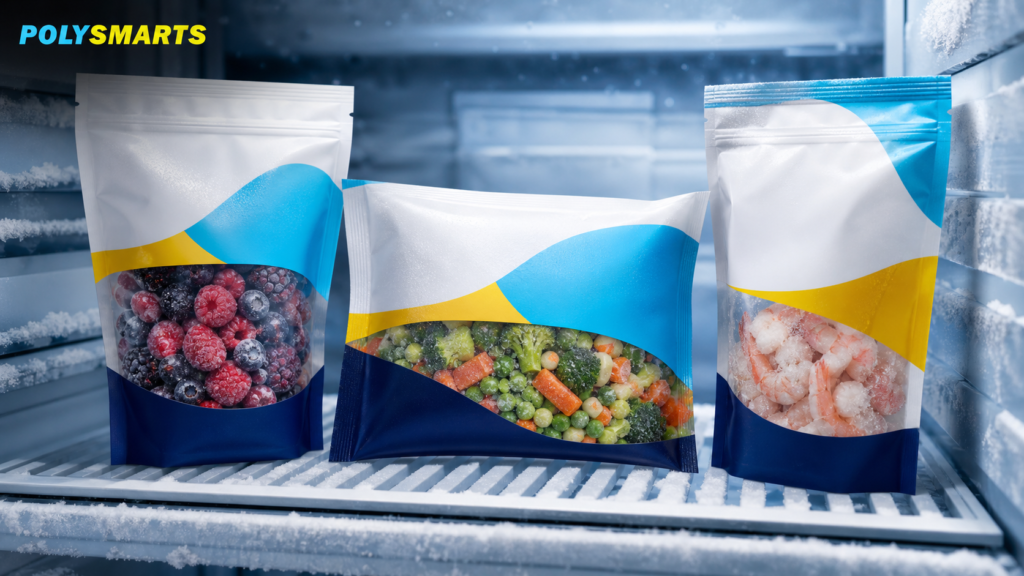
Vacuum seal bags for food are heat-sealable flexible pouches designed for equipment that removes air before closing the package. They can reduce oxygen exposure, limit moisture loss, organize portions, and help protect frozen food from dehydration. They do not sterilize food, destroy pathogens, or automatically make perishable food safe at room temperature.
Quick answer
Match the bag to the vacuum machine, food, process, and storage conditions. External suction sealers usually need textured or channeled bags so air can escape; chamber machines commonly use smooth pouches because pressure changes around the entire bag. Confirm food-contact suitability and temperature limits, keep the seal area clean, validate seal integrity, and refrigerate or freeze perishable foods promptly under an appropriate food-safety plan.

A vacuum packager removes air from the package and heat-seals the open end. With less oxygen around the food, oxidation and the growth of many aerobic spoilage organisms may slow. Tight film contact can also reduce moisture transfer and surface dehydration during frozen storage.
Vacuum packaging is a form of reduced-oxygen packaging. This changes the microbial environment; it does not make the package sterile. Some harmful organisms can grow or form toxin under reduced-oxygen conditions if the food, temperature, time, acidity, water activity, process, and other controls allow it. Commercial operations should have a qualified food-safety specialist determine applicable federal, state, and local requirements.
| Bag type | Typical equipment | How air is removed | Selection notes |
|---|---|---|---|
| Smooth pouch | Chamber vacuum sealer | The pouch and product sit inside a chamber; pressure is reduced around the whole package before sealing. | Confirm chamber size, seal-bar length, pouch opening, liquid handling, and machine settings. |
| Embossed or channeled bag | External suction or edge sealer | A textured surface creates paths for air to reach the machine’s suction area. | Use the machine manufacturer’s accepted bag design; texture pattern, seal compatibility, and roll or pouch format matter. |
Phone users can swipe horizontally to view the complete table.
Machine designs vary, so treat this as a general rule rather than a universal guarantee. Check the sealer manual and test the exact bag. A bag can appear closed while retaining air or having a weak, wrinkled, or contaminated seal.

| Potential function | Important limitation | How to verify |
|---|---|---|
| Reduce oxygen around food | Residual oxygen, film permeability, leaks, and food shape affect the result. | Vacuum-level or residual-oxygen checks plus seal and leak testing |
| Limit freezer dehydration and odor transfer | Punctures, poor seals, excessive headspace, and unsuitable film reduce protection. | Frozen-storage trial with visual, mass, sensory, and package-integrity review |
| Compact and portion products | Vacuum can crush delicate foods or pull liquids into an external sealer. | Representative fill trial using appropriate vacuum and seal settings |
| Support a validated shelf-life system | Vacuum alone does not establish safety or a universal extension period. | Product-specific food-safety and shelf-life study under defined conditions |
Phone users can swipe horizontally to view the complete table.
For households, vacuum-sealed perishable foods still require prompt refrigeration or freezing. Follow government storage guidance and the food’s safe handling instructions. When thawing, use a safe method such as refrigeration; do not assume an intact vacuum package makes room-temperature thawing safe.
Vacuum sealing is not canning and is not a substitute for a validated thermal process. A tight package can suppress visible spoilage while reduced-oxygen hazards remain possible. Discard food with damaged, swollen, leaking, or questionable packaging; never taste food to determine whether it is safe.
Restaurants, processors, and other food businesses may be subject to specialized reduced-oxygen packaging controls. The FDA Food Code identifies hazards including Clostridium botulinum and Listeria monocytogenes and sets criteria for reduced-oxygen packaging in retail food establishments. Applicability varies by product, process, jurisdiction, and business type. Obtain advice from the regulatory authority and a qualified process or food-safety specialist rather than copying household instructions.
A bag used only for refrigerated or frozen vacuum storage is not automatically suitable for cooking, hot filling, pasteurization, boiling, or sous vide. Temperature and time can affect film, seals, additives, migration, and package strength. Use only a documented construction for the intended food-contact conditions and follow a validated cooking, chilling, and storage process.
Vacuum pouches often combine layers with different functions. An outer layer may provide toughness, temperature resistance, or printability, while an inner layer provides food contact and heat sealing. Other layers or coatings may contribute oxygen barrier. The right combination depends on the product and process; a material family name or total thickness alone does not predict performance.
Sharp bones, shells, corners, ice crystals, and frozen edges can puncture film. Liquids, grease, powders, crumbs, or folds in the seal area can create channels. Wider or double seals may help in some applications, but only when compatible with the machine and validated process. Do not compensate for a poorly matched structure simply by increasing vacuum or seal time.
Write the acceptance criteria before the trial. Record the food lot, bag lot, machine, vacuum and seal settings, operators, fill weight, headspace, sanitation controls, and storage conditions. Sample packages from the beginning, middle, and end of the run rather than approving a single ideal pouch.
Inspection may include seal appearance and width, seal-strength or burst testing, leak detection, residual oxygen or vacuum retention, puncture and flex-crack resistance, drop and abrasion testing, package dimensions, print durability, and cold-storage performance. Shelf-life work should use the actual product and include appropriate microbial, chemical, physical, and sensory endpoints selected by qualified specialists. Define what happens when the film, sealant, dimensions, food formulation, equipment, settings, supplier, or process changes. A controlled validation and change-management record is more useful than a generic claim that a bag is “heavy duty” or keeps every food fresh for a fixed period.
Polysmarts’ custom frozen-food packaging page can support an initial discussion of freezer applications. It should not be treated as proof that every listed structure is a vacuum, cook-in-bag, or sous-vide solution.
Browse Polysmarts’ custom packaging bags and custom printed plastic bags, then send a complete product and process brief. Final suitability should be established with documentation and representative filled-package testing.
No. Vacuum sealing alone does not sterilize food or replace refrigeration, freezing, canning, or another validated preservation process.
They can slow some oxidation, moisture loss, and aerobic spoilage, but there is no universal multiplier. Results depend on food, sanitation, initial quality, temperature, residual oxygen, film barrier, seal integrity, and storage time.
No. The bag must match the machine’s air-removal and sealing system and be suitable for the food, process, temperature, storage, and regulatory requirements.
The channels provide a route for air to reach the suction area when the bag walls are pressed together. Check the exact machine instructions because equipment designs vary.
Typically not with standard external suction machines because smooth layers may collapse together and block airflow. Use the machine manufacturer’s specified bag type.
No. A storage pouch is not automatically designed for cooking. Verify the complete construction for the intended food, temperature, duration, and process, and follow validated food-safety controls.
Possible causes include product or liquid in the seal, wrinkles, incompatible film, incorrect settings, punctures, flex cracks, damaged bags, weak seals, or channels around bones and sharp food edges.
A second seal may add redundancy in some operations, but it is not a substitute for compatible film, a clean seal area, correct settings, and validated seal integrity.
The best vacuum seal bags for food are selected as part of a complete system: machine, food, sanitation, material, barrier, seal, storage, distribution, and food-safety controls. Match smooth or embossed bags to the equipment, verify the intended conditions of use, test filled packages, and never treat reduced oxygen as a substitute for safe temperature and process control.
 English English
  Français
 Español
 Deutsch
 Português
 日本語
日本語
 العربية
 한국어
한국어
 简体中文
简体中文